A cornerstone is the first stone laid when building the foundation for a new building. The Impostor Overdrive is the first project that I’ve started and finished to a level of quality and polish that constitutes a complete, finished product. Starting off the “building” of my works.
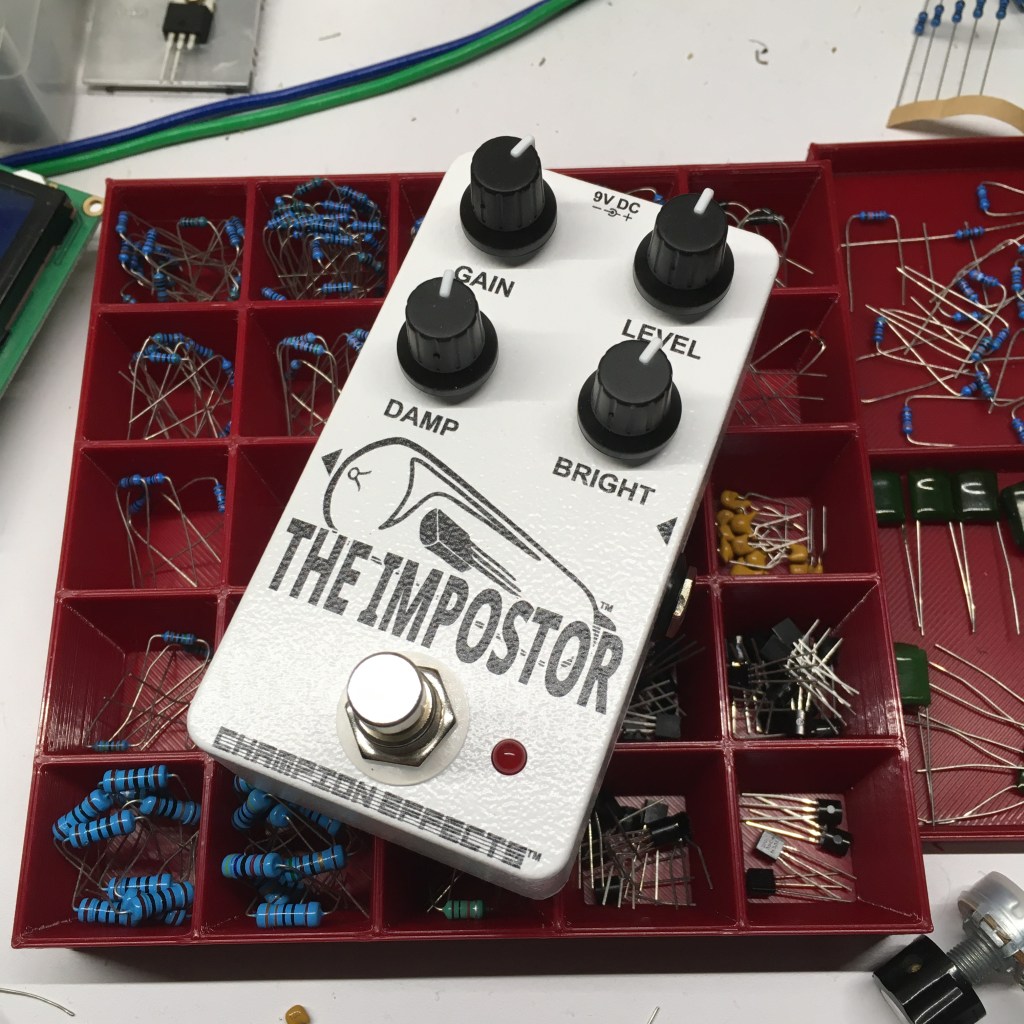
The Backstory
I’m a classic Les Paul/Marshall guy. Tube amps are the de-facto standard for good tone among electric guitarists. For a long time, I wanted a Marshall tube amp. Fast forward a little, I got a kit to build a 50W tube amp. Specifically, the 2204 circuit designed by Marshall. I ran it through the speaker of a solid state Marshall 1×12 combo amp before I got a Marshall 2×12 for it. I even put my own custom badge on it that says “Champion”. So I took the 1×12 and left it at my church so I could bring my amp head and just hook it up. It was fun to finally have a real tub amp to play through. Until I got tired of wheeling my guitar, pedalboard, and amp back and forth every week. So I wanted to build a pedal for myself that could take the place of the amp when I go anywhere but home.
The Inception
I’m an engineer. Not by profession or by education, but by mindset and action. I have a technical mind and an intuition to solve technical problems. Electronics have been an interest of mine since I was old enough to use a screwdriver to take apart all my old electronic toys as a child and our electronic junk in the house. Back to the present; I’ve built a few guitar pedals up to this point, but they all fell short of their marks. However, they weren’t failures—they were valuable learning experiences. With all the electronics engineering knowledge that I had acquired up until this point, I knew without a doubt that it was possible to build a solid state overdrive pedal that sounds no different from the preamp section of a tube amp.
Early Prototype
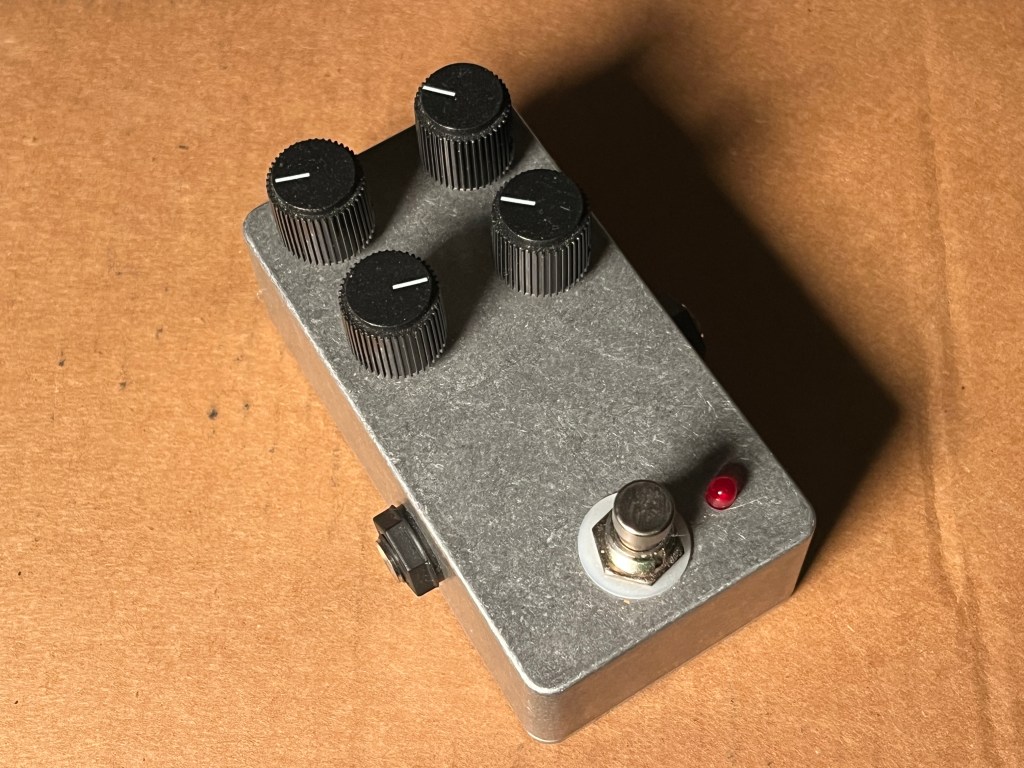
Since I like Marshall amps, I decided to copy the sonic qualities of my Marshall (third-party kit) amp. There are a few different types of transistors used to build preamps and overdrives. The bipolar junction transistor (BJT) is very common, but has a very sharp sound when overdriven. Not suitable for getting the same characteristics of an overdriven tube preamp. Field-effect transistors (FETs) on the other hand were just what I needed. Specifically, MOSFETs. I knew this going in, and I had some laying around (or I bought some, I don’t remember now) and built some cascading preamp stages, just like how tube preamps are built. But most of the work isn’t in the gain topology, but in the EQ shaping. Long and technical story short, I tinkered with the EQ at various stages in the preamps, A/B testing against the gain in my amp by ear, until I wasn’t able to tell a difference anymore. Even the subtleties and the “feel” while playing through it were the same as the tube amp. This took a week. It had quite a lot of hiss in the background that needed to be dealt with, but it went from idea to working prototype in a week.
The Struggle
This section is going to summarize a long time period that could be a book all by itself in just a few hundred words. I spent the next few weeks testing (using) the pedal in place of my amp. I ran it through an analog amp sim (basically fancy EQ). It’s not an amp or cab sim by itself; just overdrive. Then I spent another few weeks figuring out how to reduce the hiss to an acceptable level. I ended up using BJTs for clean gain, and MOSFETs for overdrive, and used them in differential pairs to cancel common mode noise. This worked very well. So I designed a printed circuit board (PCB) and switched from through-hole (THT) electronics, which I was using on the breadboard, to surface mounted (SMD) ones for the PCB. Then I went straight to Hammond to customize a 1590B2 enclosure, and ordered the minimum of 25 after a couple weeks of back-and-forth with the mod shop. Now, a year since I started designing the original prototype, almost to the day, I’ve built a website and registered a DBA in West Virginia, and launched. Except I discovered a few flaws. For the next week, I worked frantically to find and fix the source of a loud squealing sound that happened when the settings were maxed out. The other issue was an obvious, easy one that was a component tolerance thing. Both issues were able to be worked around and resolved with the next PCB revision. The marketing struggle was the biggest though.
The Lesson
I made the classic business mistake of “solving a problem nobody has”. This is really only partly true. What I really did was underestimate the difficulty of brand-building in a saturated niche. Many brands—even micro-brands—do very well in the guitar pedal market. But I went for the big brand marketing strategy. Create social media accounts and run ads. I can say first hand that nobody wants to buy from Mr. Unknown what they perceive as the same thing they can buy from Dunlop, Electro-Harmonix, or TC Electronic. I learned one way not to build a new brand. Nonetheless, my brand, Champion Effects, isn’t going anywhere. But it’s more of a passion project, at this point, than a business. Custom physical products are not the best thing to sell when building a first business, so I’m focusing my efforts elsewhere for the time being.
What I Took Away from the Experience
I learned what it takes to develop a product at every step from idea to market. I iterated on the breadboard past the “good enough” point where I previously would have stopped. I wasn’t going to put my name on it and sell it if it was only “good enough”. I wanted completion, and I didn’t stop until I had reached it.
I learned how to design modifications (drilled holes, printed graphics) to off-the-shelf enclosures in CAD software and correspond with the mod shop of the manufacturer to get them made.
I learned how to properly design a PCB in EDA software (also a form of CAD software) based on a schematic made in the same software suite to fit in the enclosure and have everything line up with the holes in the enclosure.
I learned how to set up and run ads on Facebook and Google and drive clicks to my website. My clickthrough rates were actually pretty good. My website wasn’t converting clicks into sales.
All things considered, the struggle was more valuable than a lack thereof. I learned all the aforementioned hard skills, but I started sharpening my soft skills in a way that would not have been very effective without negative feedback. I learned a lot of what not to do and how not to go about business, and a little still of what to do.
“I have not failed. I’ve just found 10,000 ways that won’t work.“
— Thomas Edison
 The Andrew Neal
Leave a comment